
Pipeline Confidence Guide
Pipeline confidence:
The five conditions that connect GTM execution to revenue
Pipeline confidence means knowing the business has a predictable path to revenue, and where it would break down first.
The five conditions for pipeline confidence
Jump to
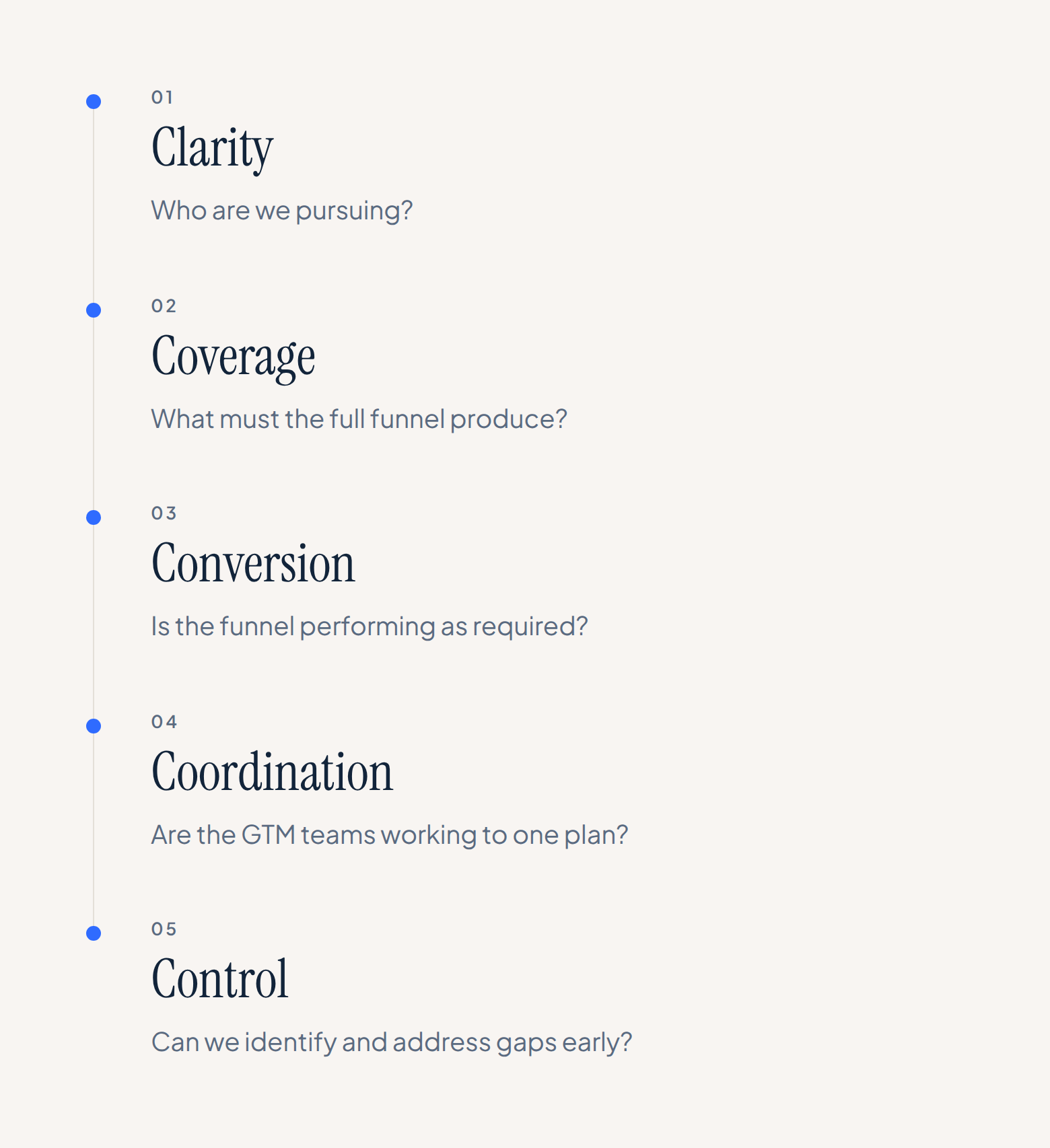
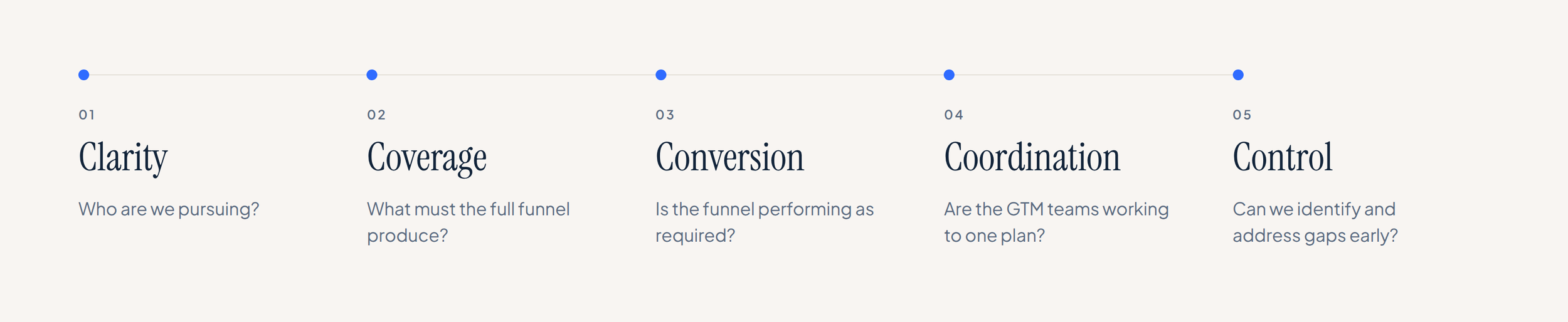
CLARITY | COVERAGE | CONVERSION | COORDINATION | CONTROL
Each condition answers a different question about the revenue plan: where growth will come from, whether there is enough pipeline potential to support it, whether the funnel is converting as expected, whether the GTM teams are working as one system, and whether leadership can identify problems early enough to act.
1. Clarity
We have a clearly defined ICP and shared priorities for the markets, segments, accounts and buyers we are pursuing.
Pipeline confidence starts with agreement on where growth is expected to come from. Most B2B SaaS companies have an ICP, target industries, company sizes, personas and perhaps named-account lists. The more important question is whether those choices are specific enough to determine where GTM resources are concentrated.
An ICP that accommodates almost anything provides little direction. Marketing, business development and sales begin working from different priorities, while new segments and opportunities are added without corresponding decisions about what will receive less attention.
A useful ICP makes those trade-offs explicit. It should guide which segments receive investment, which accounts are actively pursued, which buying groups matter, which programs get built and where sales capacity is deployed. If the revenue plan depends heavily on a particular segment, the GTM plan should show a corresponding concentration of resources against it.
“A useful ICP tells you where to concentrate, and what to walk away from.”
2. Coverage
We know the full-funnel volume required to hit the revenue target, and the market opportunity, investment, capacity and program mix needed to support it.
Leadership should be able to work backward from the revenue target to determine how many closed-won deals, qualified opportunities, conversations and engaged accounts are required to support it.
The specific stages will vary by GTM motion. An account-based motion may work back to engaged accounts and ICP reach. A product-led business will use different stages and signals. The principle remains the same: start with the revenue target and work backward to define what is required at each stage of the funnel.
The objective is not perfect prediction. It is to make the assumptions behind the revenue plan explicit enough to test whether the plan is achievable.
The funnel math is only the first step. Leadership also needs to determine whether those numbers are realistic given the size of the addressable market, available investment, team capacity and demand plan. If they are not, the revenue plan and the GTM model supporting it are out of alignment.
“The plan can look right on a spreadsheet and still fail if the market, budget or team can’t deliver it.”
Work backward from the revenue target
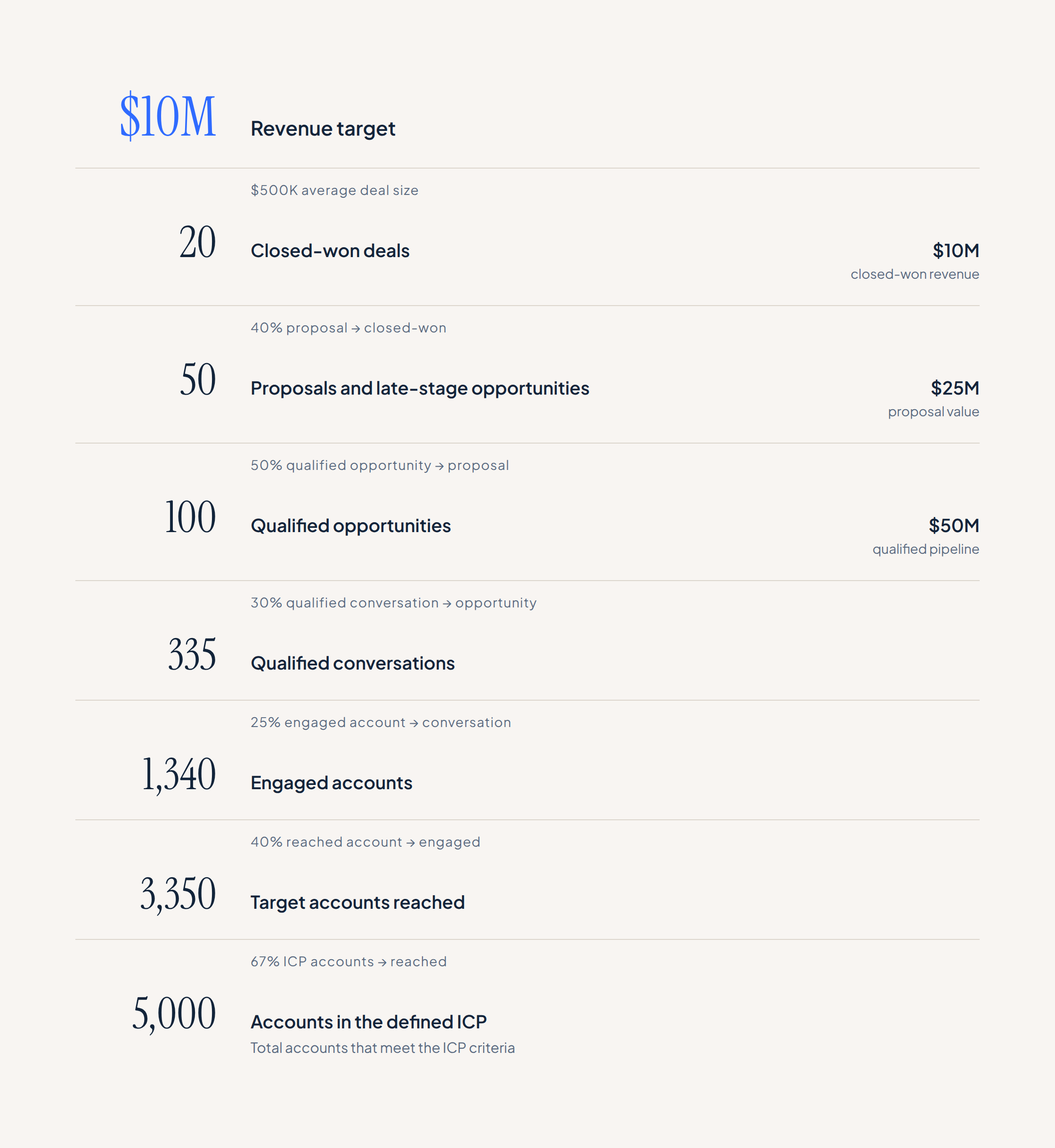
Illustrative example only. Funnel stages, definitions and conversion assumptions will vary by GTM motion, segment and sales cycle.
3. Conversion
We know the conversion rates required at each stage of the funnel and where performance is above or below plan.
Sufficient volume is only part of the revenue model. Accounts and opportunities also need to progress through the funnel at rates that can support the plan. When actual conversion starts to diverge from those assumptions, leadership needs to know where the change is occurring.
That requires consistent funnel definitions. Marketing, business development and sales should agree on what the major stages mean, what qualifies an account or opportunity to enter each stage and the criteria for moving to the next stage.
Consider two sellers. Seller A creates an opportunity after an initial discovery call. Seller B waits until a defined business problem, buying process and credible project have been established. If both records appear in the same opportunity stage, the pipeline number may look precise while representing very different levels of qualification. Conversion and close rates become less trustworthy as a result.
“Your conversion rate might just be measuring how optimistic your reps are.”
Definitions and qualification criteria should be reflected in the systems and reporting used to manage the funnel. Conversion assumptions should also reflect the company's own economics and GTM motion. Historical performance, adjusted as the business changes, is generally more useful for planning than a generic benchmark.
Looking at conversion stage by stage improves diagnosis. Strong reach with weak engagement requires a different response from healthy opportunity creation with deteriorating win rates. Leadership needs to see not only how much volume exists, but how efficiently it is progressing toward revenue.
4. Coordination
Marketing, business development and sales work against shared targets, with clear primary accountabilities, handoffs and expectations.
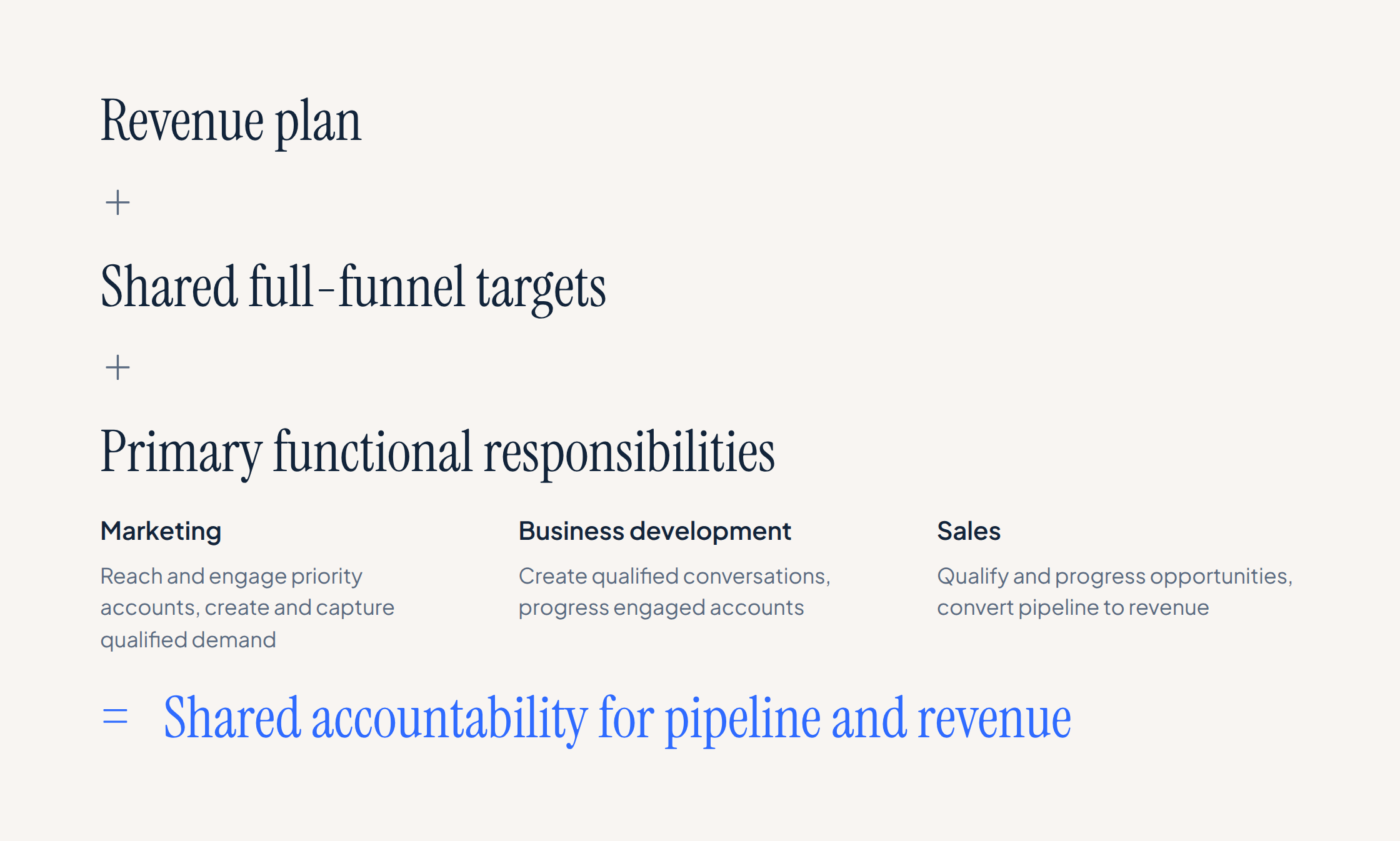
The stages that lead to revenue span marketing, business development and sales. Each GTM function needs its own measures to manage performance, but those measures also need to connect to the same full-funnel revenue model.
“Functional targets only work when they add up to the pipeline and revenue the business needs.”
Without that connection, every function can appear to perform while the company still misses revenue. Marketing can hit its demand target. Business development can hit its meeting target. Sales can have pipeline to work. If the combined system is not creating and converting enough qualified pipeline, the functional successes do not add up to the required business outcome.
Shared targets provide a common reference point, while primary accountabilities clarify what each team is expected to contribute. That does not mean assigning exclusive ownership to every stage. AEs prospect, marketing influences active opportunities, partners create demand and product usage generates buying signals. The objective is clear primary accountability within a shared revenue model.
From revenue plan to functional responsibility
Clear handoffs make that model operational. Teams should know when primary responsibility changes, what criteria must be met, what follow-up is expected and what happens when an account or opportunity is not ready to progress.
Shared targets and clear handoffs assume the organization has the people to execute them. A coordination model can be well designed on paper and still fail if roles are unclear, headcount has not kept pace with the plan, or the skills a stage requires do not exist on the team yet.
5. Control
We track performance against the assumptions in the plan and identify gaps early enough to adjust.
Aggregate pipeline and revenue are lagging indicators. Leadership also needs visibility into the measures that precede them, such as ICP reach, target-account engagement, qualified demand, conversation volume, opportunity creation, stage conversion, pipeline aging, win rate and pipeline coverage.
Timing matters. In a business with a six-, nine- or twelve-month sales cycle, a revenue shortfall visible today may have originated months earlier. Account engagement may have fallen below target, opportunity creation may have slowed or conversion may have deteriorated upstream.
Without that visibility, leadership can respond to the wrong problem: add sales capacity when qualified pipeline is insufficient, increase marketing investment when conversion is the constraint, or fail to reallocate resources when a segment is underperforming.
“Wait for revenue to show the problem, and the best options are already gone.”
Illustrative operating cadence
WEEKLY: Execution and immediate issues
MONTHLY: Pipeline creation, conversion and meaningful variance from plan
QUARTERLY: ICP priorities, channel performance, investment allocation, conversion expectations and capacity
The annual plan establishes the assumptions. The operating cadence tests them throughout the year and gives leadership a structured way to respond when they stop holding.
When pipeline falls behind
Pipeline shortfalls create pressure for more activity. The five conditions are a better starting point. Weak reach points to Clarity or Coverage. Healthy reach with too few qualified conversations points to Conversion or Coordination. Healthy opportunity creation with revenue still behind points to sales process, deal aging or win rate. If leadership can't see the gap until revenue is affected, Control is weak.
More campaigns, more outbound and more sellers aren't the default answer. Neither is AI. It adds execution capacity, but only helps when the operating model underneath is already sound.
Five questions to ask about your pipeline confidence
Have the CEO, CRO, CMO and RevOps leader answer each question independently, then compare notes.
Clarity: Do we have a clearly defined ICP and shared priorities for the markets, segments, accounts and buyers we are pursuing, and are our GTM resources aligned accordingly?
Coverage: Can we work backward from the revenue target through the full funnel, and do we have the market, investment, capacity and program mix required to produce those numbers?
Conversion: Do we know the conversion rates required at each stage of the funnel, and are our definitions and data consistent enough to understand where performance is above or below plan?
Coordination: Are marketing, business development and sales working against shared targets, with clear primary accountabilities, handoffs and expectations?
Control: Are we tracking performance against the assumptions in the plan frequently enough to identify gaps and respond while there is still time to affect the outcome?
Different answers across the leadership team often expose hidden assumptions, conflicting definitions, gaps in the funnel model or real uncertainty about how the revenue target will be delivered.
Pipeline confidence, by design
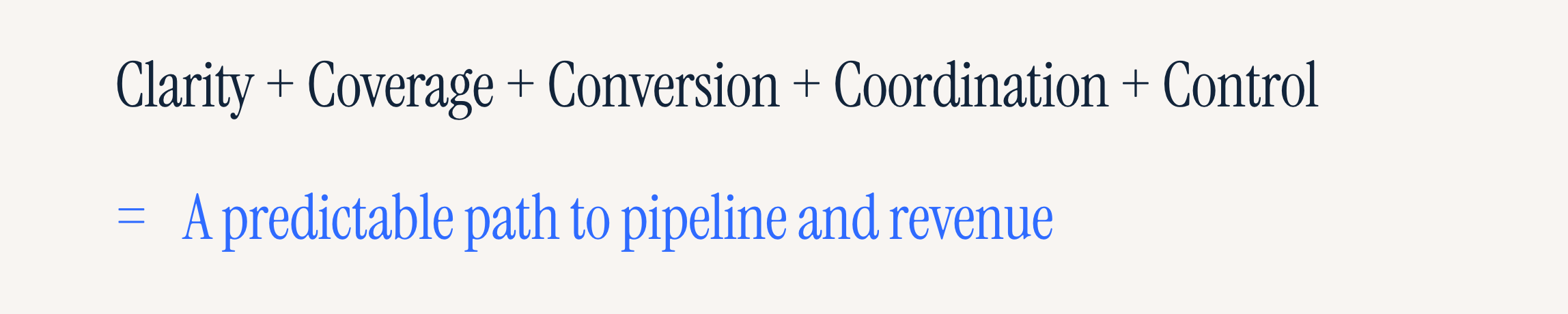
None of the five conditions works alone. Together, they buy leadership time to act before a problem reaches revenue.
Acton Hunter builds the GTM operating model that connects marketing, business development and sales to pipeline and revenue.
The GTM Revenue Audit applies this framework to your business to identify where pipeline and revenue performance are breaking down, what is creating the constraint and which actions should take priority.